admin22 Archive
The Breakdown of Fixed Text in Three-Dimensional Reality Traditional subtitles were designed for a stable rectangle. The viewer sits in front of a screen, the image remains within a predictable frame, and a caption strip can occupy the lower margin without competing with the story. In 360-degree video, virtual reality, and augmented reality, that assumption
The High Cost of Atmospheric Video Backgrounds Cinematic video backgrounds and frosted glass interfaces create immediate emotional resonance. Motion can establish pace, atmosphere, and brand character before a user reads a single word, while translucent surfaces suggest depth and spatial hierarchy. The problem begins when typography is asked to perform on top of active pixels.
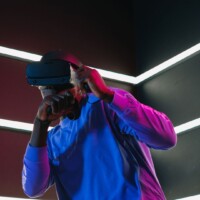
Moving Beyond Flat Floating Screens in Spatial Computing Mixed-reality interfaces become less convincing when they are treated as ordinary two-dimensional windows simply hung in mid-air. A panel can be technically legible and visually polished yet still feel misplaced, unstable, or strangely demanding to use. The problem is not the presence of depth itself. The problem
Why Glass Feels Lifeless Without Tactile Rhythm Modern touch interfaces can render depth, translucency, motion, and responsive visual states with remarkable sophistication. Yet beneath those effects, the user still touches a perfectly flat surface. The contrast is fundamental: the screen may suggest a physical button, dial, or textured control, while the fingertip receives no corresponding
The Silent Friction of Modern Digital Soundscapes Interface audio occupies a delicate space between clarity and fatigue. A short confirmation can reassure a user that a payment went through, a file saved, or a command registered. The same confirmation, repeated without context, can become a source of irritation within minutes. In modern products, sound is
The Perils of Motion-Heavy Storytelling Scrollytelling has transformed the way digital stories explain complex subjects. A reader can move through a climate record, a public health simulation, or an election map while text, charts, images, and video respond to the position of the viewport. When the choreography is disciplined, scrolling becomes a form of narrative
The Interaction Paradox in Digital Documentary Interactive documentaries promise something conventional film cannot fully provide: the ability for viewers to choose where to look, whose testimony to follow, and how deeply to investigate a subject. That promise also creates a difficult editorial problem. Every additional choice can strengthen a viewer”s sense of participation, but it